
By Claude Schippers, Jolandie Buck & Dr Wilhelm De Beer
Driving down some of the dusty back roads of the Gouritz Cluster Biosphere Reserve, with landowners and conservancy members who know this landscape intimately, we looked out over the valleys. A notable break in the natural flow of the veld and indigenous vegetation is dense stands of invasive prickly pear (Opuntia species), pushing outwards and taking hold.
As we walked into these thickets together, moving carefully between spines, we began placing infected cladodes onto healthy plants. It is hands-on work, shared between partners across the landscape, each release a small but deliberate act to restore this landscape. We know it won’t be long before the signs begin to show: the yellowing of succulent pads and the gradual collapse of what once seemed like an immovable invasion.
Prickly pear may look harmless (even pretty), but in the Gouritz Region it has become an ecological problem. Several species of invasive cactus, particularly prickly pears like Opunita ficus-indica, Opuntia stricta and Opuntia monacanthatha, have spread beyond their original planting sites, threatening biodiversity, land productivity and ecosystem health.
Addressing this challenge has not been the work of a single organisation. It is a collaborative effort across the landscape, with the Gouritz Cluster Biosphere Reserve (GCBR), local conservancies, private landowners and research institutions working together to implement long-term, sustainable solutions. Central to this partnership is the Rhodes University Centre for Biological Control (CBC), who provide the scientific expertise and biocontrol agents that make this work possible on the ground.
How did prickly pear become a problem?
Opuntia ficus-indica, O. stricta and O. monacantha are not indigenous to South Africa.
- Opuntia ficus-indica originates from Mexico and was introduced to South Africa several centuries ago. It is a hybrid species that was selectively bred for spinelessness and high fruit quality. Today, various cultivars are still widely used as a source of fruit and fodder, as well as for hedge planting.
- Opuntia[JB1] stricta originates from North and Central America, introduced to South Africa in the early 20th century as an ornamental plant and a living fence for livestock and as a household boundary.
- Opuntia monacantha native to South America, arrived much early, already being present in the Cape by the late 1700’s, where it was planted for living fences, livestock enclosures and fodder during droughts.
What began as practical solutions for landowners has, over time, shifted into a widespread ecological issue. These species now form dense, spiny thickets that outcompete indigenous vegetation, restrict the movement of wildlife and livestock, and reduce the productivity of the land. In many areas, landowners are left managing landscapes that have fundamentally changed.
Why do prickly pears spread so easily?
Managing prickly pear is particularly challenging because of how effectively it spreads across the landscape, often with the unintended assistance of both natural processes and human activity.
- Fruit-eating animals such as birds, baboons and monkeys disperse seeds over long distances.
- Broken plant fragments (cladodes) root easily when they touch soil, especially after disturbance.
- Floods, road construction and dumping of garden waste further assist the spread across the landscape.
This combination makes prickly pear extremely difficult and costly to manage using mechanical or chemical methods alone.
Biocontrol: a proven, long-term solution
To tackle this challenge, GCBR and its partners are using host-specific biological controlinsects supplied by the CBC, which feed only on invasive Opuntia species and pose no risk to indigenous plants.
- Prickly pear (Opuntia ficus- indica) and Common prickly pear (Opuntia stricta)[JB2] is controlled using the cochineal insect Dactylopius opuntiae.
- Smooth prickly pear (Opuntia monacantha) is controlled using a closely related species, Dactylopius ceylonicus.
These sap-sucking insects attach to cactus pads (cladodes) and slowly weaken the plant. Infested pads begin to yellow, rot and fall off and over time the entire plant collapses. Small plants can die within months, while larger plants may take one to two years to fully decline.

South Africa has a long and proud history of cactus biocontrol. In fact, the introduction of Dactylopius ceylonicus in 1913 to control smooth prickly pear was the country’s first successful biological control programme and remains one of the most effective examples of biocontrol globally.
Making biocontrol work on the ground
While the science behind biocontrol is well established, its success depends on people working together across the landscape.
Landowners and conservancy members play a critical role in identifying infestations, hosting release sites and actively participating in the spread of biocontrol agents. Infested pads are carefully transferred onto healthy plants by field teams, landowners and partners, accelerating the natural spread of the insects.
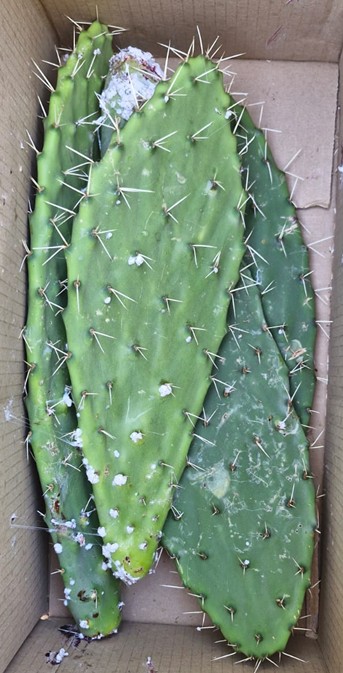
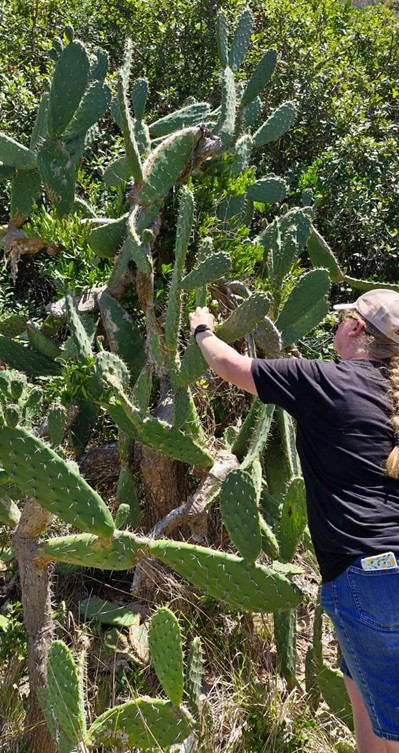
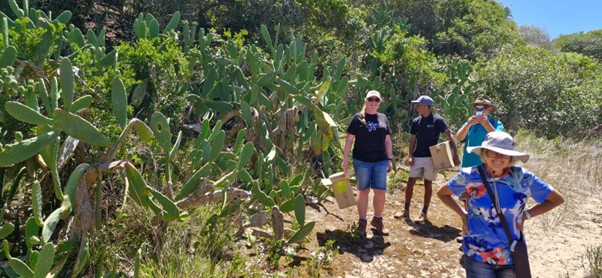
Environmental conditions can influence success. Heavy rainfall may temporarily reduce insect numbers by washing them off plants or exposing them to predators. To counter this, releases are carefully timed for drier periods and placed in sheltered microhabitats to improve establishment and survival. This adaptive approach relies heavily on local knowledge, with landowners and conservancies providing insight into site conditions and helping guide effective placement.
Why these matters
These collaborative efforts are already making a difference. By reducing invasive prickly pear:
- Indigenous vegetation can recover
- Grazing land becomes more accessible
- Long-term management costs are reduced
- Ecosystem resilience across the Gouritz Region is strengthened
Biological control is not a quick fix, but it is a sustainable and cost-effective solution when supported by strong partnerships. The success seen so far is a direct reflection of the collaboration between research institutions, conservation organisations, conservancies and committed landowners.
A Shared effort
This work would not be possible without the ongoing support of Danabaai Conservancy, MidBrak Conservancy, Great Brak River Conservancy, Brandwacht Game Reserve, Johnsons Post, Outeniquabosch Lodge and Venue, Duiwenhoks Conservancy and Pauline Bohnen Nature Reserve.
Together, these partnerships are not only managing an invasive species; they are actively restoring and protecting the ecological integrity of the Gouritz Region.
Supporting and Assisting Partners:
Duiwenhoks Conservancy – https://duiwenhoksconservancy.co.za/

Further readings on Invasive Plants
https://www.ru.ac.za/centreforbiologicalcontrol/programmes/cactaceaeprogramme
https://www.arc.agric.za/arc-ppri/Pages/Prickly-pear.aspx
https://wwfafrica.awsassets.panda.org/downloads/invasive_alien_plants_in_south_africa.pdf
https://pza.sanbi.org/sites/default/files/info_library/pricklypear_kruger_0.pdf
https://www.arc.agric.za/arc-ppri/Leaflets%20Library/Cactus%20biocontrol-%20general%20aspects.pdf
Zimmermann, H.G., Moran, V.C. and Hoffmann, J.H., 2004. Biological control in the management of invasive alien plants in South Africa, and the role of the Working for Water Programme: working for water. South African Journal of Science, 100(1), pp.34-40.