
By Claude Schippers & Jolandie Buck
Driving along the farm roads between Brandwacht and Grootbrak, you begin to notice something unusual climbing the slopes. At first glance, it looks striking, large, sprawling succulents draped over shrubs and trees. But look closer, and it becomes clear that this is not part of the natural system.
Standing with members of the Great Brak River Conservancy, we point out dragon fruit pushing beyond garden fences, creeping into natural areas, and slowly suppressing indigenous vegetation. It is not yet everywhere, but it is spreading. And importantly, it is still at a stage were, working together, we can stop it from becoming something far more difficult to manage.
Dragon fruit may be celebrated around the world for its striking appearance and nutritional value, but in South Africa, this seemingly harmless plant is telling a very different story. What was once introduced as an ornamental curiosity and commercial crop is now quietly escaping cultivation and establishing itself in natural ecosystems, where it is threatening biodiversity.
In the Gouritz Region, where maintaining healthy and resilient landscape is a conservation priority, the spread of dragon fruit highlights an emerging concern; not all introduced species remain contained or beneficial once established in a new environment. Some, like dragon fruit, adapt all too well and spread rapidly, outcompeting indigenous vegetation and altering dynamics in way that are costly and difficult to reverse.
Recognising this early, the Gouritz Cluster Biosphere Reserve (GCBR), in collaboration with Groot Brak River Conservancy and the Centre for Biological Control, has begun implementing proactive management interventions. Central to this effort is the Centre for Biological Control at Rhodes University, whose research and supply of biocontrol agents supports science-based, long-term solutions on the ground.
From Central America to South Africa
Dragon fruit (Hylocereus undatus), native to Central America and southern Mexico, is a conservation concern in South Africa. Initially introduced as a garden ornamental and commercial fruit crop, this cactus has spread beyond cultivated areas into natural ecosystems.
As a fast-growing climbing cactus, dragon fruit can grow into the canopies of tall trees, where the sheer weight of its succulent stems may cause branches or entire trees to collapse. It forms dense thickets that smother indigenous vegetation and outcompete native plants for light and space, causing a growing threat to biodiversity if left unmanaged.
Landowners across the region are increasingly noticing these changes, often first seeing isolated plants along fence lines or drainage areas before they expand into larger infestations.
How does dragon fruit spread?
The species spreads through fruit-eating birds that disperse seeds over wide areas, as well as through disposal of plant material. Even small stem fragments are capable of taking root and establishing new plants, making improper disposal a risk factor for further spread.
Dragon fruit is listed as a Category 2 invasive species under the National Environmental Management: Biodiversity Act, which means it may only be grown, sold or transported with a valid permit. Responsible planting, disposal and early intervention are important to prevent this species from becoming a widespread invasive problem.
By identifying and managing emerging invasive species early, GCBR and its partners can prevent long-term ecological damage and reduce future management costs. Proactive action plays an important role in maintaining healthy, resilient landscapes across the Gouritz region.
Biological Control: Natural solution
To help manage dragon fruit invasions, the cactus mealybughas been released as a biological control agent. This insect has established well at release sites and has proven to be highly damaging to the invasive Dragon fruit.
While large, heavily infested plants may take time to die, they produce far fewer flowers and fruit, which limits their ability to reproduce. Smaller plants and seedlings often die much more quickly. In cases where infestations become sparse, the insects may not naturally spread to nearby plants and may need to be transferred manually to prevent populations from dying out.
Manual transfers are best done during spring and summer, and not after rainfall, as rain can remove the insects from the plant.
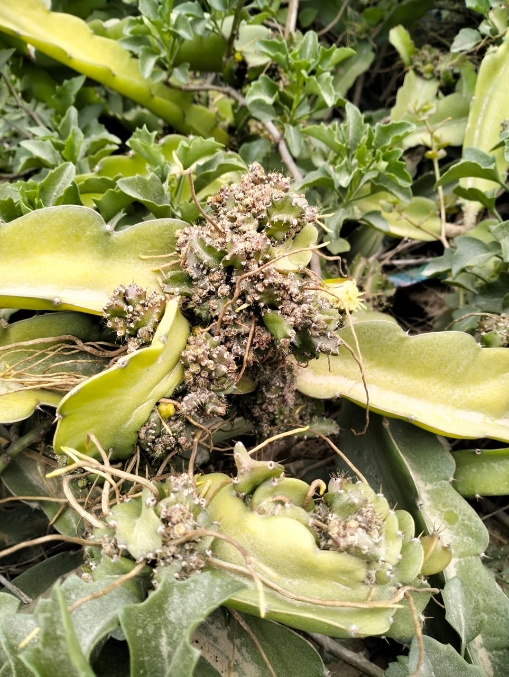

What does the mealybug look like?
Mealybugs live in colonies and are covered in a mass of white, waxy threads. These colonies are usually found clustered around distorted growth tips of the cactus. Adult females are pinkish, about the size of a pinhead and remain hidden beneath the waxy covering for their entire lives.
The life cycle begins when females lay single eggs that hatch almost immediately. The newly hatched nymphs, known as crawlers, have functional legs and move to the growing tips of plants. From there, they can be carried by wind to nearby plants, where new colonies form. Females become immobile as they mature, while males develop wings and disperse in search of females.
Understanding what the cactus mealybug looks like and how it behaves is important for monitoring in the field. By acting early and working collaboratively, the spread of dragon fruit can be contained before it becomes a widespread and costly problem. These efforts not only protect biodiversity but also reduce future management costs and maintain the ecological integrity of the Gouritz Region.
This is not a once-off intervention, but an ongoing, shared process that depends on strong partnerships between research institutions, conservation organisations, conservancies and committed landowners.
A word of thanks
GCBR would like to sincerely thank the Great Brak River Conservancy and the landowners who continue to support and participate in these efforts.
Together, these partnerships are allowing us to respond early, act strategically, and protect the landscape before the problem becomes unmanageable.

Further Reading:
https://www.sanbi.org/wp-content/uploads/2018/11/National-Status-Report-web-6MB.pdf
http://realipm.co.za/integrated-pest-management-solutions-for-dragon-fruit/#:~:text=Dragon%20fruit%20are%20not%20immune,orchard%20and%20cause%20economic%20losses
https://www.thegardener.co.za/grow-to-eat/fruit/the-risks-of-growing-dragonfruit-in-your-garden/#:~:text=What%20does%20the%20law%20say,it%20absolute%20immunity%20from%20scrutiny
https://www.arc.agric.za/arc-ppri/Fact%20Sheets%20Library/Hypogeococcus%20pungens,%20mealybug.pdf\