
By Jolandie Buck, GCBR Landscape Manager
When most people think of bees, they picture a honeybee moving between flowers or the familiar bee boxes used by beekeepers. But the Western Cape is home to an extraordinary diversity of bee species, many of which most people never notice. From cloning honeybees to giant carpenter bees and tiny nectar-bubbling masked bees, these insects play a critical role in maintaining the biodiversity of the Gouritz Cluster Biosphere Reserve (Gouritz Biosphere).
International Bee Day is an opportunity not only to celebrate bees, but also to recognise the important ecological services they provide. Pollination supports indigenous plant reproduction, healthy ecosystems, food production, and ultimately the resilience of the landscapes we depend on.
The Cape Honeybee: Nature’s Clone-Making Bee
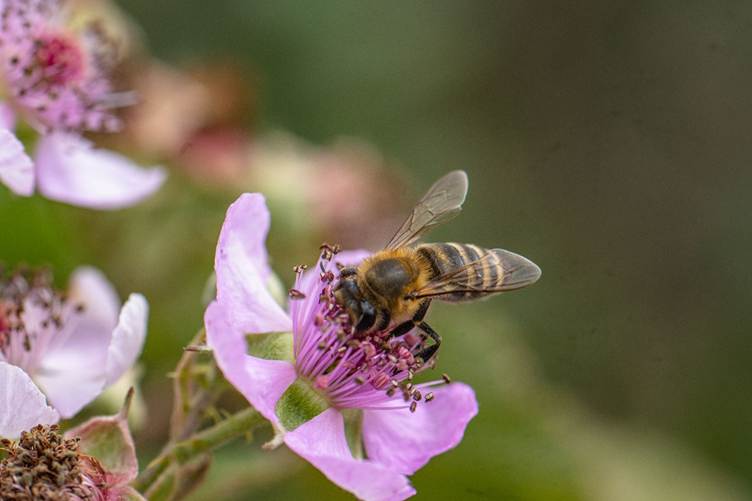
One of the most fascinating bees in South Africa is the Cape honeybee (Apis mellifera capensis), a subspecies found primarily in the Western Cape. While honeybees already have highly complex social structures, Cape honeybees possess an ability that makes them globally unique.
In most honeybee colonies around the world, worker bees are sterile females that support the queen by collecting food, caring for larvae, and defending the hive. Cape honeybee workers, however, can reproduce without mating through a process known as thelytokous parthenogenesis. This allows female workers to produce female offspring that are essentially clones of themselves.
Under normal conditions this ability can help a colony survive if something happens to the queen. But it can also create problems.
Certain Cape honeybee workers can become what are known as “social parasites.” These workers enter other honeybee colonies, particularly colonies of African honeybees outside of the Cape region and begin laying clone-producing eggs. Because the workers can mimic the chemical signals of the host colony, they are often accepted by the hive. Over time their offspring increase in number, placing pressure on the colony and eventually contributing to its collapse.
This behaviour became a major issue in the South African beekeeping industry after Cape honeybees were accidentally transported beyond their natural range. Entire apiaries were affected as parasitic workers spread through commercial hives. It remains one of the most unusual and well-known examples of social parasitism in bees anywhere in the world.
Despite this, Cape honeybees remain important pollinators within their natural range and form part of the unique ecological diversity of the Western Cape.
Carpenter Bees: The Giant Solitary Architects
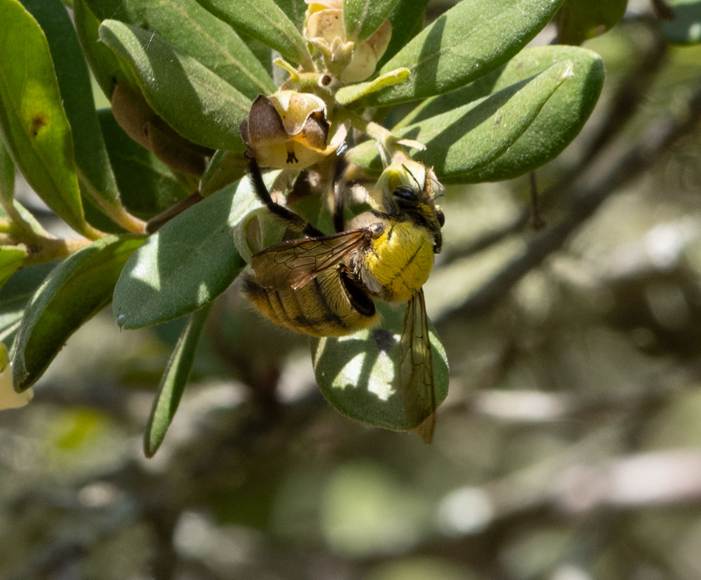
While honeybees live in colonies, many of South Africa’s indigenous bees are solitary. Among the most noticeable are carpenter bees (Xylocopa species), large, powerful bees often seen visiting flowering plants in gardens, veld, and fynbos habitats.
Carpenter bees are named for their nesting behaviour. Females use their strong jaws to excavate tunnels into dead wood, dry stems, or soft plant material where they create chambers for their offspring. Inside these tunnels, the female places pollen and nectar as food before laying an egg and sealing the chamber.
Unlike termites or wood-boring beetles, carpenter bees do not eat the wood. They simply use it as a nesting site. These nests may be reused and expanded over multiple generations.
Although carpenter bees are solitary, they are incredibly important pollinators. Their large size allows them to carry substantial amounts of pollen, and many indigenous plants rely on them for effective pollination. Some species are also capable of “buzz pollination,” where vibrations from their flight muscles help release pollen from flowers that other pollinators struggle to access.
Because carpenter bees depend on dead wood and natural vegetation for nesting habitat, overly tidy gardens and the removal of old stems or dead trees can reduce available nesting sites. Leaving small patches of natural habitat, hollow stems, and dead wood can help support these important pollinators.
The Tiny Masked Bees That Blow Nectar Bubbles
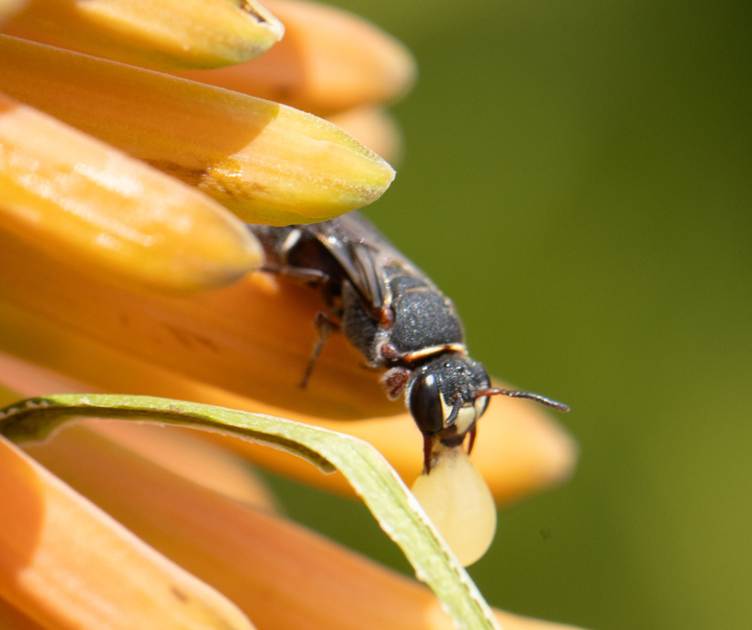
Some of the Western Cape’s most fascinating bees are also some of the smallest. Masked bees (Hylaeus species) are tiny solitary bees often recognised by the pale yellow or white markings on their faces, which resemble masks.
Unlike many other bees, masked bees carry pollen internally in their crop rather than externally on hairy legs. This gives them a smoother, almost wasp-like appearance.
One of their most remarkable behaviours involves nectar concentration. Researchers have observed masked bees repeatedly regurgitating droplets of nectar and holding them between their mouthparts as exposed bubbles. By doing this, water evaporates from the nectar, concentrating the sugars before the bees swallow it again or return to their nests.
This “bubble blowing” behaviour may look unusual, but it is an incredibly efficient adaptation that helps the bees process nectar more effectively.
Masked bees often nest in hollow stems, tiny cavities, or old insect burrows, making natural vegetation and intact ecosystems important for their survival. Despite their small size, they contribute to pollination networks that support indigenous flowering plants across the landscape.
Protecting Pollinators in the Gouritz Biosphere
The Gouritz Biosphere supports an extraordinary diversity of plant life, particularly within the Cape Floristic Region. This biodiversity depends heavily on pollinators, including bees that are often overlooked.
Habitat loss, pesticide use, invasive alien plants, and climate change all place pressure on pollinator populations. Supporting indigenous vegetation, reducing unnecessary pesticide use, and maintaining natural habitat features such as dead wood, bare ground, and flowering plants can make a significant difference for bee diversity.
International Bee Day reminds us that conservation is not only about protecting large mammals or iconic species. Sometimes the health of an entire ecosystem depends on the tiny insects moving quietly between flowers every day.
From cloning honeybees to wood-carving carpenter bees and nectar-bubbling masked bees, the bees of the Western Cape continue to reveal just how remarkable nature can be.
References:
Eardley, C., Kuhlmann, M., & Pauly, A. (2010). The bee genera and subgenera of sub-Saharan Africa.
Goudie, F., & Oldroyd, B. P. (2014). Thelytoky in the honey bee. Apidologie, 45(3), 306–326.
Johnson, S. D. (1992, June). Buzz Pollination Of Orpheum Frutescens. Veld & Flora, 36–37.
Kuhlmann, M. (2009). Patterns of diversity, endemism and distribution of bees (Insecta: Hymenoptera: Anthophila) in southern Africa. South African Journal of Botany, 75(4), 726–738. https://doi.org/https://doi.org/10.1016/j.sajb.2009.06.016
Mumoki, F. N., Pirk, C. W., Yusuf, A. A., & Crewe, R. M. (2022). Anniversary of a beekeeper’s discovery of thelytoky in Cape honey bees. South African Journal of Science, 118(11–12), 1–4.
Portman, Z. M., Ascher, J. S., & Cariveau, D. P. (2021). Nectar concentrating behavior by bees (Hymenoptera: Anthophila). Apidologie, 52(6), 1169–1194. https://doi.org/10.1007/s13592-021-00895-1
Watmough, R. (1973). Biology and behaviour of carpenter bees in southern Africa. Journal of the Entomological Society of Southern Africa, 37(2), 261–281.